
What is colour theory?
Colour theory is the study and explanation of how different colours work together and how different colours make you feel different emotions when used in the right setting. For artists, colour theory is a way for them to convey a certain emotion or to convey a good visual.
Colour wheels
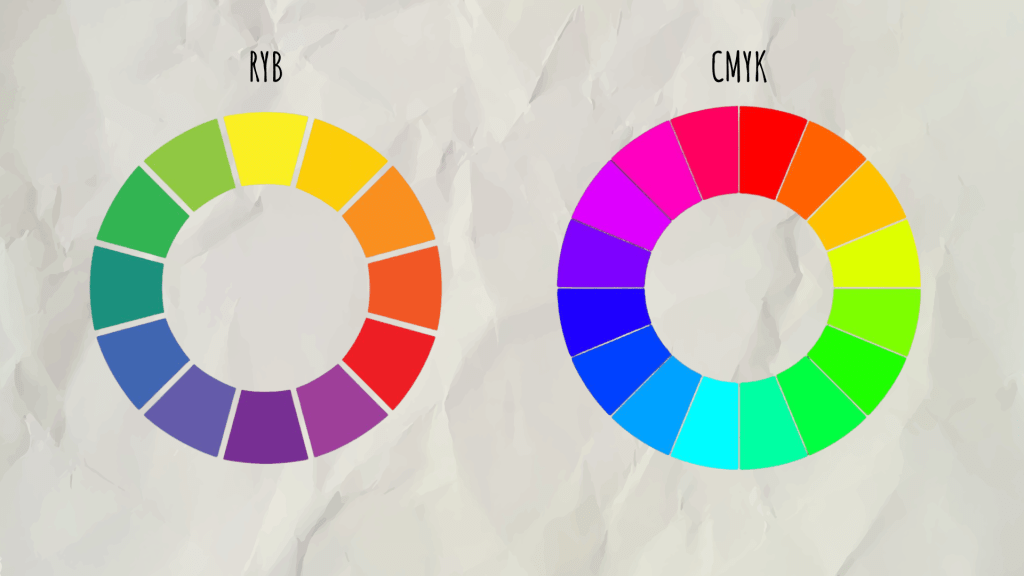
Within art there are two primary colour wheels that are used, the RYB (red, yellow, blue) wheel and the CMYK (cyan, magenta, yellow and black) wheel. To start off, a colour wheel is a circle split into twelve even sections. Each section contained a different colour that was either mixed or placed there. In these twelve sections are three separate colour categories. Primary, secondary and tertiary. Primary colours are colours that you cannot mix and can only be found from a raw material. Secondary colours are colours that are mixed from primary colours and can easily be mixed. Tertiary colours are colours mixed from secondary colours, adding to the colour range of a colour wheel.
RYB (Red, Yellow, Blue)

The RYB colour wheel is one of the most taught and a majority of the time the only taught colour wheel in both elementary and secondary school. This colour wheel was also the most commonly used among modern art painters such as Frida Khaulo, Leonardo Divinci and others. The RYB often has less saturated colours, creating a great visual for painting from life and landscape paintings but isn’t great for wanting to create or mix up more vibrant colours.
CMYK (Cyan, Magenta, Yellow, Black)

The CMYK colour wheel is the colour wheel used for all your printers. This wheel is often only self taught or taught in post-secondary art universities or colleges. The colours in this wheel are used greatly among artists who are abstract painters or just wish for their paintings to be more saturated. The colours tend to be more saturated and give a wider range of colours for it to mix.
Complimentary Colours
Complimentary colours are just as said, complementary. Complimentary colours are colours that compliment each other, giving a good visual contrast. Complementary colours are colours that are across from each other in a colour wheel. Examples for RYB would be green and red, yellow and purple, and blue and orange. Examples for CMYK would be yellow and blue, magenta and green, and cyan and red. If complimentary colours are mixed together they create brown.